Let the words of my mouth and the meditations of all our hearts be acceptable in your sight, O Lord, our strength and our redeemer (Psalm 19:14).

Wednesday, December 8, 2010

Thanksgiving Day

The Beauty of Holiness

It may surprise you to hear that preaching on Thanksgiving poses great risks for the preacher. Theological disaster lurks at every point. It is like sailing along the most hazardous and rocky of coastlines.

A big part of the challenge arises when we try to bring what is really a civic holiday into the church. Theologically speaking, our thanksgivings go awry. A recent blog linked on the Christian Century website listed many of the horrendous theologies that underlie much of our Thanksgiving preaching and piety.

But I will spare you the rant. I know that is not why you are here—to hear me rave against inappropriate Thanksgiving theology.

I do try, in my own prayers on this day, to focus less on counting my blessings, like a child counting presents under the Christmas tree to make sure there are “enough” or more than his brother has… (oops, I wasn’t going to rant.) I try to focus more on praying that God will transform me. I pray that God will transform me into a more grateful person. That God will give me a grateful heart for the benefits and blessings I do enjoy.

This year, in particular, I pray that I will remember to be grateful for the opportunity to worship. Not for the political freedom to gather for worship. That is a civic benefit we enjoy in this country, and one I think we should cherish and work to ensure that all people may enjoy that benefit.

But regardless of political time or place, human beings are created in such a way that we have the desire and capacity for worship. That’s really pretty remarkable and wonderful. Like remembering. Or creating. Worship is a part of our human potential. And I am grateful to have been created by God with the potential for worship, to be wired with the desire and capacity for worship.

The psalmist says, “I thank you that I am wondrously made.” Part of being wondrously made is being wired for worship.

Evelyn Underhill defines worship as: “The adoring acknowledgment of all that lies beyond us—the glory that fills heaven and earth. It is the response that conscious beings make to their Creator.” We have the capacity and the desire to adore the glory of God. Thank God that God has given us hearts to know and love him.

The psalmist also says, “Worship the Lord in the beauty of holiness.” The beauty of holiness surrounds us all. Regardless of the circumstances of our lives. Regardless. The beauty of holiness surrounds us all. And we have been given the ability to see it and a way to respond. It is a great blessing to be able to worship, to have a means of responding to the beauty of holiness in our lives.

Worship in this sense is more than coming together in corporate worship, although that is a powerful blessing. Worship is losing ourselves in the presence of God. Joining that “mystic sweet communion” that the hymn describes. It is to live praise. To celebrate the beauty of holiness.

It is a wonderful thing to be created with the desire and capacity for worship. For that, I thank God.

The Last Sunday after Pentecost

Clint Eastwood and Sally Bingham

Diocesan Convention reminded me of a Clint Eastwood movie. Or it might be more accurate to say that during diocesan convention I was reminded of a particular Clint Eastwood movie.

The annual convention of the Episcopal Diocese of Chicago was this past Friday and Saturday. The theme this year was Relate, Renew, Restore; Caring for God’s Creation. The focus was on sustainability. The keynote speaker was Canon Sally Bingham, an Episcopal priest and activist on behalf of the environment. Her message was both dire and hopeful. She spoke about the irreparable loss that has already occurred to God’s creation. Irreparable. We are currently standing right on the brink between the world that God created and another world of human of human making which is literally unsustainable.  (You may listen to the audio of her presentation here.)

It is unfortunate that climate change and other environmental issues have become ammunition in partisan political wars. The science is real and irrefutable. Species loss, environmental degradation of air and water, climate change profoundly threaten God’s creation.

Yet people of faith are a source of hope. We are a source of hope in this crisis not only because we see the earth as God’s own creation, and therefore of immeasurable value, but also because we are called by our baptismal vows to care for other people. To be motivated by more than self interest. It is part of our vocation to be the voice for people who have no voice. There are two populations in particular who have no voice: One is the poor and/or less educated. And the second is the unborn. The poor and less educated throughout the world are suffering disproportionately because of climate change and other environment problems and yet do not have the voice or power to speak out. And the unborn, the not yet born only a few generations from now, are being robbed of beauty, health, even their lives by our selfish abuse and exploitation of God’s creation. It’s not just about us. As people of faith we are compelled to speak up and act on behalf of the powerless and to be stewards of creation for generations yet unborn.

It was listening to Sally Bingham that reminded me of a Clint Eastwood movie or actually just one particular scene from a Clint Eastwood movie. I had to do a little internet searching to confirm which movie it was. Pale Rider, I think. I can’t imagine why I saw it several decades ago. It is set, as so many early Clint Eastwood movies are, in the violent and rough world of the wild west. A mining town is troubled by violence between the powerful and the powerless. A mysterious preacher rides into town. In that violent setting—very significantly—he is unarmed. Yet he stands up for the downtrodden. Without the power of a gun, he acts on behalf of the powerless. In a sense he symbolizes God’s peace and God’s power.

Conflict continues, however, and at one point the preacher makes a solitary journey to a bank safe deposit box. As he opens the drawer we see a pistol and gun belt. He takes out the gun and in the climax of the scene he drops his clerical collar into the box.

It’s a troubling scene. The preacher is meant to be a positive character, one we are rooting for. Yet this scene implies that he has some higher calling that he can only pursue by abandoning his role as a Christian. It plays upon the romantic appeal of the lone avenger, justifying violent revenge.

It’s that image of him taking off his collar that has stuck with me all these years. Exchanging his preacher’s collar for a gun. Choosing to put aside his Christian identity so that he could perform an unchristian task.

I wear a collar, of course. I’m not sure what a clerical collar means to you. Basically it is a symbol of someone who takes the Christian life seriously. Nothing more, nothing less. For us as Episcopalians it signifies a specific role within the church. But out in the world it simply signifies someone trying to live the gospel in daily life. And that is everyone’s vocation.

I don’t know if you’re aware… you don’t have to show any credentials to buy one. You don’t have to prove your ordination or show testimonials of sanctity. It could be a powerful exercise for everyone to wear one for a few days, even if only in your imagination. It would challenge us to face those times when we—you and I—choose to take it off. When we choose to put aside our Christian identity to perform unchristian tasks.

I’m not talking about the casual sins of inattention that are a part of all human life. I’m thinking of the big choices, the deliberate acts we choose to undertake in direct violation of our Christian identity.

Those times, for example, when we choose our personal convenience or our selfish interests at a cost to the flourishing and blessing of other people.

These seem to be appropriate reflections, not just on the heels of diocesan convention, but for this last Sunday of the church year. A time for taking stock.

What do you do in your life that you have to take your collar off to do? When do you deliberately choose to put aside your Christian identity?

Two biggies came up in convention. One was environmental exploitation. I personally felt “convicted” on environmental issues, even though I consider myself as someone who cares about the environment. Until it comes time to buy a new vehicle. Then I take off my collar and pick whatever suits my own convenience. And I have spoken quite openly about how I choose the convenience of single-use plastic bags over more responsible options. Never mind the consequences. Millions and millions of baggies. At what cost? I choose to put aside my Christian vocation just for selfish convenience.

The second issue that arose at convention was bullying. Convention passed a resolution condemning bullying. The anti-bullying resolution arose out of recent events in which young people perceived to be gay have been driven to suicide. But discussion was clear that bullying is a much broader issue. It happens on the schoolyard, in society, in corporate life and even between nations. It is any abuse of the powerless by the powerful. For any reason. Or for no reason.

You must take your collar off if you choose not to intervene. A failure to act in the face of bullying or any abuse of power is unchristian. To favor personal convenience or comfort or to affect indifference are choices contrary to our Christianity.

Clint Eastwood’s solution was also unchristian. He took off his collar so that he could beat up the bad guys, escalate the violence, abuse the powerful with even greater power.

It occurs to me that rather than taking his collar off and shooting up all the bad guys Clint Eastwood should have left his collar on and then gone out to stand between the bad guys and those they were exploiting.

But he didn’t. In his role as the preacher, he chose to put aside the ways of Jesus for the ways of the world.

When do you do the same?

When do you choose to put aside your Christian identity to perform an unchristian task? When to you deliberately choose selfish comfort or convenience over the blessing or lives of others?

This last Sunday of the church year reminds us of the profound importance of the choices we make in life. Reflect. Reflect on those times when you deliberately take off your Christian vesture, your Christian identity, to act in a selfish or worldly way. Next Sunday is a new beginning, the first Sunday of Advent. And in the collect for that day we will pray that by God’s grace we may reverse the preacher’s action. In the great Advent collect we will pray that we may cast away the works of darkness… that we may take off the works and vesture of darkness… and put upon us the armor of light.

Saturday, November 6, 2010

The Twenty-Third Sunday after Pentecost

God's Orchestra

There’s a lot going on in Chicago, especially in the arts and other cultural opportunities. I love it and partake of quite a few offerings. And I know many of you do, too. Downtown, here in the south suburbs, the theater in Munster. Even if you’re not someone who has a strong interest in concerts or plays, stay with me if you can in your imagination. With so many offerings, how do you decide when to go, which events to attend? How do you pick a date? How do you choose between organizations? And, if you have a choice, how do you pick location and price for your seats?

As many of you know, I love opera. So that decision’s easy. I go to them all. And I sit in pretty good seats. But I also really enjoy the symphony. And there I need to pick and choose. I consider the program and soloists, looking for things I particularly like. I look at other things that may be on my calendar. I weigh the cost of the tickets, balancing what it feels like it’s worth, how much I can spare for at least a halfway decent seat.

Going to the symphony isn’t life or death. I didn’t have it in Maine. But I missed it. It profoundly enriches my life. So I’m very glad to have the world-class CSO right here and to be able to go when I can, or when the program particularly interests me. For the CSO, I don’t contribute beyond whatever ticket price I’ve settled upon. I do contribute to the opera. Although not to Lyric, per se. I leaf through the glossy program and see all those big time donors, philanthropic foundations, moguls of industry, mavens of society, and I figure with all those heavy hitters they don’t need me. My modest contribution wouldn’t mean much. So I support the Ryan Center, Lyric’s young artist training program for up and coming singers.

Does all of this sound at all familiar? Maybe you approach your cultural experiences the same way. Or maybe this is how you approach the Christian life.

I always get a bit depressed this time of year, the time of the annual pledge campaign. It feels like such a struggle. People become defensive, dismissive and small. It’s depressing to see people at their worst.

It certainly appears that a lot of people approach the Christian life much same way I approach the CSO. I know I do sometimes, which is why I think I can recognize it in others.

In this perspective the Christian life is an experience offered by an organization, the church. Partaking of the Christian life isn’t a matter of life or death. It is a commodity, offered by the church. It definitely enriches life, and is worthwhile and beneficial. Even more so than the CSO. But we approach the Christian life as a “consumer,” or an “outsider” who takes advantage of what the church offers when we choose, when we have the time or motivation, when we particularly like the program and our schedule permits.

It is wonderful that the church offers us the opportunity to experience the Christian life and we are very grateful to be able to take advantage of it and participate in its offerings. And we definitely get something out of the experience. Unlike the CSO, however, it’s totally free. Always. So we are left to decide how much money or time we’re willing to give to ensure the house stays open, the organization remains afloat. Like someone who attends the symphony, those decisions are based upon balancing other obligations, presumably some assessment of how much personal benefit we derive from experiencing what is offered, and our own judgment of how worthwhile the organization is. And, perhaps like me and Lyric, we consider whether our contribution will make a difference, be significant.

This is a perspective on the Christian life. It doesn’t have anything to do with how often you pray of how much you give. It’s a perspective. The perspective from the audience. Even if I go to the symphony every night and sit in the most expensive seats, my perspective is still from the audience. I am an individual choosing to take part in an experience offered by some organization.

You think I’m criticizing this perspective as an approach to the Christian life. I’m not. As an approach to the Christian life, sitting in the audience is much, much, much better than abstaining or total indifference. Thank God, and I mean this very sincerely, we have an organization like the church to expose us to a taste of the Christian experience. To get us started.

And most of our typical stewardship material is geared towards this perspective. We assure you that this organization, the church, is a worthwhile one and that it will use your contribution responsibly. We assure you that your contribution is needed and we urge you to really consider how much you value what the church offers you. Those are good things to think about.

But…

God offers us something so much more wondrous. God invites each of us, all of us out of the audience into the orchestra. Out of the audience into the chorus. To be participants in God’s own music making. To have a part in creating and bringing great beauty and hope into the world.

It’s a totally different perspective from the orchestra. No longer is music something you are given by some organization. It’s a part of you. This is who I am; this is what I do. All of me is involved in music making.

This time of year, you hear a lot about giving and offering, and the vestry is sharing some wonderful reflections on giving with you. But from the perspective of the orchestra, the words giving and offering don’t really have much meaning. Participation is the only word that makes sense. No one in an orchestra would ask, “How much of my music making ability shall I give to this performance? Shall I offer every tenth note?” In an orchestra, you can’t not make music. You play your part, with God’s help, as best you can.

God help us all to step out of the audience and join the orchestra.
This is all just a metaphor, of course. The Christian life is not dependent upon musical talent.

What does it feel like to be a part of God’s orchestra? Fulfilling. A powerful sense of being in the right place, free from fear and anxiety.

How do we actually get up from the audience into the orchestra? You’ll be glad Episcopalians typically don’t do altar calls. It’s too bad. It would hurt you to actually get up. But it is a conscious decision. Not so much to give your life to Jesus, as our more evangelical brothers and sisters might say. For me, it’s not so much a question of giving, as joining. Joining in a shared endeavor with God. Choosing to view every aspect of your life as coupled with God, joined with God’s purpose. Try it. It brings a deep joy and celebration to those endeavors that are, in fact, shared with God. And it makes it much easier to let go of those that are not shared with God. And if you are really, intentionally, consciously trying to join your whole life with God’s own being, you can usually tell the difference between what is shared with God’s desire and what is not.

For most people this is a very different perspective on spending money, but it’s gloriously freeing. Think of every act of spending money as coupled with God’s presence. Spending money is like playing in God’s orchestra. It doesn’t mean you have to give up everything you enjoy. In fact, it brings heavenly joy to those expenditures that are life-giving. And it makes it much easier to let go of those that are not.

A change of perspective. From the audience into the orchestra.
As important as this transition can be in our lives as Christians, in some ways the church itself does not help. Look at how this space is set up. It’s like a concert hall. You are the audience looking to the altar where the church presents God’s work to you.

And then there’s Communion. We can’t help but experience it as the church, as an organization, giving us a little bit of Jesus when and if we decide to come on any given Sunday. We do, by God’s grace, receive the living Christ when we come to Communion. Thank God. But no wonder we tend to think of the Christian life as being given an “experience of Christ” by the Church.

When Jesus shares himself with us in Holy Communion, we are receiving the fruits of his passion. The fruits of his passionate life and death. New life. Grace. Forgiveness. Hope. The fruits of Jesus’ passion.

To show compassion is to spread those fruits throughout the world. That is the music of God’s orchestra. To act with com-passion. To participate in bringing the fruits of Jesus’ passion to the world. Compassion. Any act that brings new life, grace, hope… and, I might add, wonder and beauty into the world.

It might be a word of concern or support. Or some shared new creation. Or a prayer of intercession on behalf of someone in need. Or sharing resources that you have with someone who needs them. Or walking hand-in-hand. Compassion. Any act that is a part of bringing the fruits of Jesus’ passion into the world.

Try a little exercise as we participate in Holy Communion this morning. Whatever your typical practice may be during the time when everyone else is receiving Communion, this morning say a prayer for each person as they are given the Body and Blood of Christ. “I pray that you may know the fruits of Jesus’ passion in your life… I pray for you.” And imagine yourself, not sitting in your pew or kneeling at the rail, but standing up there side-by-side with the risen Christ. Side by side with Christ looking out this way at the world. Seeing what he sees. Sharing his hopes and desires for the world. As we all participate in Communion, imagine sharing the experience from Jesus’ point of view. It’s a different perspective.

And remember, too, as we all together pray with Jesus’ for new life and hope for one another in the world… all those prayers together will make glorious music, God’s music of hope and new life for the world.

Monday, October 25, 2010

The Twenty-Second Sunday after Pentecost

Drawing by Kate Parrent, 1988

Church Buildings


There was a short segment on the NBC national news Friday night about a “new” movement in American religious practice. It must have been a slow news day. The reporter described people choosing to meet in relatively small groups in “house churches.” Groups of twelve or fifteen people meet in someone’s home for Sunday worship. There’s nothing new about this practice, of course. It was the norm in the earliest days of Christianity. In the first centuries of the Christian movement, all Christians met for worship and fellowship in “house churches.

The practice has a lot to commend it. For one thing, it encourages, even demands, full and active participation from everyone present.

Meeting as a house church also eliminates the “overhead costs” of maintaining a physical “house of worship.” The pastor shepherding the group that was highlighted in the news segment said one woman had told him “she was tired of paying someone else’s light bill in addition to her own.” It is expensive to maintain a church building, or any building for that matter. Energy costs, maintenance, insurance.

Then there is the other issue of congregations that have lost their way by worshiping the Tiffany windows or the marble carved reredos or the Flentrop organ instead of worshiping Jesus. A church building is not always an asset to a faith community.

The church is the people, not the building. Do we even really need a building? The news report cited a recent Pew research study indicating that 9 % of American Protestants now worship solely in house churches. They have no church building.

As it turns out for me personally there was a deep poignancy of the timing of that news report, although I did not know it at the time.

Only a few hours before that news report was broadcast, late Friday afternoon, a church building that had been a very important part of my life was lost. The chapel at Virginia Seminary was destroyed by a devastating fire.

I worshiped in the seminary chapel with fellow members of the seminary community five days a week throughout my three years of seminary training. In addition, I did my field work (part time parish internship) at Immanuel Church on the Hill, a parish in Alexandria that has a special relationship with the seminary and holds one of its Sunday services in the seminar chapel. So for two years I also shared worship every Sunday in the seminary chapel with the people of Immanuel.

The pictures of the fire and its aftermath are heartbreaking. No one was hurt. No other buildings were damaged. They don’t know how it started. That’s one of those questions that we think is important, but really isn’t. It was an old building, consecrated in 1881; the interior was made almost entirely of wood.

The church is the people. The church is the life of the people. The church is the people, active. Our lives, our ministries, are the church. The church is not a building.

But church buildings have their value. Throughout the day yesterday I reflected on what church buildings can mean and be for us.

First, the buildings themselves can teach us, form us in faith. We do need to guard against dependence upon a building for our life of faith. We also need to guard against misdirecting our worship or reverence towards the building rather than God. But awe inspiring architecture can inspire awe towards the divine and lift our hearts Godwards. For centuries stained-glass windows have taught stories of faith to those who gathered beneath them. Here at St. John’s our windows inspire and teach about the exemplary lives of the saints.

The chapel at VTS had a large stained glass window that filled the wall behind and above the holy table. It portrayed Jesus speaking to his disciples who were assembled around him. The setting is Jesus’ final meeting with his disciples after his resurrection and before his ascension. Above the window in bold letters were Jesus’ Great Commission in words from Mark’s Gospel. “Go ye into all the world and preach the Gospel.” And thousands have. The window was destroyed, but those of us who worshiped there were formed and inspired by its message.

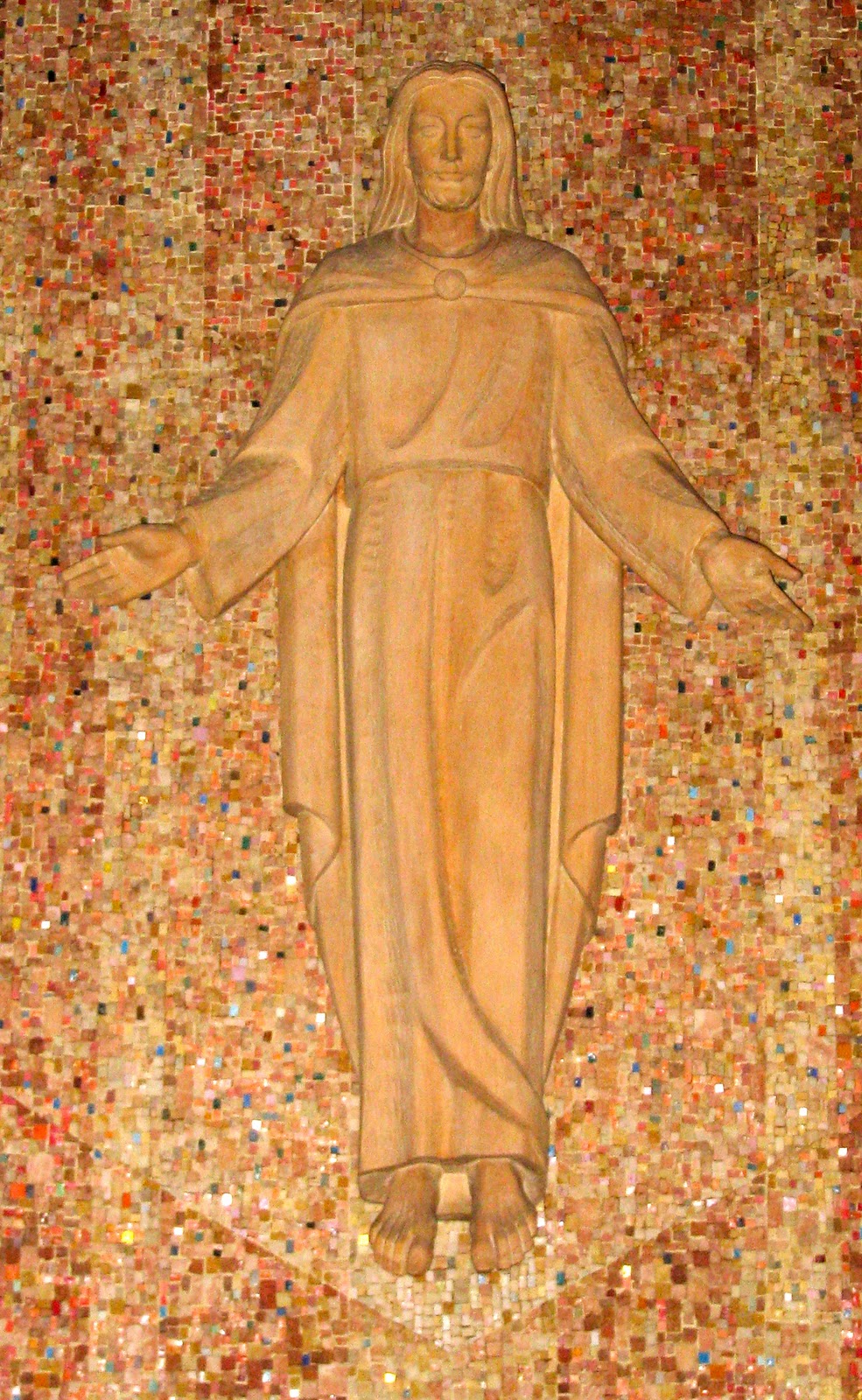
Here in this church building we look upon the risen Christ every time we gather for worship. The risen Christ, resurrected in joy and triumph. His arms are outstretched in a gesture that I have always interpreted as invitation and welcome. I hope that here in this church building we are being formed into resurrection people, people of new life and hope, reaching out our hands in welcome to others.
Church buildings themselves can teach and form us.

Second, church buildings are symbols of our connection to one another within community. It is Christ who connects us, but the building can be a symbol, a reminder. This is broadly true of many objects or settings; things can be symbols of unity or commonality for various groups of people. But it’s worth remembering that the church building can fill that function for us as a parish community. The building, after all, is where we gather to do the things we do together, as a community. It is the setting for our common life. So the building reminds and teaches us of the reality of our connection to one another in community.

That connection reaches beyond the times and occasions of our own individual experiences. This building symbolizes our connection to generations past and future.

Over the course of the last day, I have felt united to a company of people whom I have never met, whose names I do not know. I know only that they prayed and preached and cried and sang within the chapel at Virginia Seminary. It is, of course, the living Christ in whom we share true communion. But the building is a symbol of that communion. A reminder that, as Christians, we are never alone.

Finally, a church building is a container for the “fullness” of Christian life. For me I think this is a church building’s greatest gift, although perhaps the hardest to articulate. A building consecrated for worship is a sacred vessel into which we pour all of who we are. We leave nothing outside. No part of life is not holy. We bring all that we are, good and bad, warts and wonders, hopes and fears, into this holy place. And all of it is touched and blessed by God.

The rector of a parish is charged with keeping the parish records. Technically, they are the records of the parish community, but they are also the records of worship services within a church building. And those records recount the fullness of human life. Services of baptism and confirmation, of soul sickness and reconciliation, of matrimony and death. But this building holds even more than that. This holy vessel holds all of the prayers offered, the human struggles played out, the relationships lived.

When I think of all that happened in the chapel at Virginia—during worship and at other times… The walls contained times tension and whimsy, of private conversation and public celebration, anger, fear, hope, peace. When we bring our whole lives to worship, the sacred space of the building reminds us that our whole lives are lived in God’s presence.

So I grieve the loss of a church building. Many of us do, scattered throughout the church throughout the world.

Maybe my loss today has reminded you of losses of your own. I’m sorry. Give them to God, your loss and your grief. As he met with the seminary community after the fire, the Dean of the Seminary, Dean Markham, prayed that we might give our memories to God to hold in trust for our eternal life. I think that’s a wonderful perspective. Remember: good memories are what generate grief. Give your memories to God, entrust them to God. God will hold them in trust so that we may cherish them eternally.

Maybe you’ve been reminded of fires that have affected you directly or indirectly. Forgive me, but I don’t want to hear about them.

I do bid your prayers for everyone who has been affected by this fire. The seminary community and the people of Immanuel Church-on-the-Hill will be OK. They are strong in will and faith. But this is a difficult time, especially I imagine for those who are there now. The window in the seminary chapel was inscribed with the Great Commission from Mark’s Gospel. In Matthew’s gospel, the Great Commission concludes with these words from Jesus to his followers. “And remember, I am with you always to the end of the age.” I cannot imagine a community more confident in that assurance than the staff and students of Virginia Seminary.

The church is not a building.

And I still say, as I have before, “going to church” is a bizarre and meaningless phrase. Church is not a building. It is not a destination we visit from time to time. “Living as church” is the better perspective for us as Christians. But church buildings can help us live as church.

This morning, I hope you will pause and thank God for all the church buildings that have enriched your faith throughout your life, the buildings that have taught you and helped form you as a Christian. Thank God for those church buildings that have helped you build and remember your connection to the broader Christian community that is the Body of Christ. And thank God for those holy spaces, sacred vessels, into which you have poured all the trials and joys of living and known yourself to be blessed as a beloved child of God.

Tuesday, June 29, 2010

The Fifth Sunday after Pentecost

Freedom

2 Kings 2:1-2, 6-14
Galatians 5:1, 13-25
Luke 9:51-62


“The Gospel of the Lord. Praise to you, Lord Christ.” It’s a little hard, maybe, to offer praise after hearing this Gospel. There are a number of passages in the Gospels often known as the Difficult Sayings of Jesus. The words themselves are not difficult to understand, but we find their meaning difficult to accept. This is definitely one of those difficult sayings, especially Jesus’ apparently harsh and callous words “let the dead bury their dead.”

I can think of four possible approaches to difficult passages like these.

One is to put them aside. Consciously or subconsciously to discount the passages we find difficult. My God wouldn’t say something like that, we think. The God I know, the God I presume to know all about isn’t like that. If Jesus actually said this, I know he didn’t mean it. This is an extremely arrogant approach, but we all do it all the time. We choose to ignore or discount the importance of passages we don’t like.

The second approach is to go beyond the literally meaning of the words to a deeper interpretation… to interpret the passage, especially within the context of the faithful community of the church. This is certainly a valid and faithful approach to the Scriptures. It affirms that God’s revelation to the faithful community has continued since the time the Scriptures were written and that God’s people assembled in prayer and study can interpret new meanings from the Scriptures that reflect God’s ongoing will for his people. The church, today and over the centuries, can interpret and reinterpret these passages and teach us broader or deeper meanings beyond the literal. Many in the church interpret the meaning of Jesus’ words to be: Let the spiritually dead bury their physical dead. Let those who do not know the living Christ tend to those whose bodies no longer live.

It’s important to remember that if we adopt this approach of interpreting new meanings from Scripture, discerned within the faithful community… if we adopt this approach for passages we find difficult, we must be open to it for all of Scripture. We must acknowledge that passages whose literal meaning we cherish may also be open to reinterpretation.

A third approach to Scripture—any passage, difficult or not—is to use the gift of intellect God have us and turn to the tools of Biblical scholarship, especially historical criticism. This approach yields some particularly interesting results for this Gospel passage. Biblical scholars point out that the underlying agenda in this passage, whether it is Luke’s or Jesus’, is to make the point that Jesus is not Elijah. Remember that for the Jews of Jesus’ day and for the Gospel writers, this would have been an extremely important question to resolve. They were awaiting the return of the great prophet Elijah. Jews still await his return. This context is completely lost on us, but in Jesus’ day, people would have been very eager to know if Jesus was Elijah. This passage very pointedly addresses that question.

In this morning’s reading from the Hebrew Scriptures, we heard a bit of Elijah’s story, when he passes his prophetic mantle to Elisha. Keeping in mind today’s reading from Luke, listen to a few other passages from the story of Elijah as it is told in the Books of Kings. Elijah was often at odds with the Kings of Israel who were not faithful to Yahweh. One of the kings sought to eliminate the bothersome prophet and sent a messenger and fifty soldiers to take care of Elijah. When they arrived, Elijah said to them, “If I am a man of God, let fire come down from heaven and consume you and your fifty.” And, the Second Book of Kings tells, us “then fire came down from heaven and consumed him and his fifty” [2 Kings 1:10, 12]. Elijah called down fire upon those who were faithless to Yahweh. When Jesus came upon some Samaritans who were not open to the presence of the Son of God, Jesus did not rain down fire upon them. Jesus is not Elijah.

Listen to the call of Elisha from First Kings. “So he [Elijah] set out from there, and found Elisha son of Shaphat, who was plowing. There were twelve yoke of oxen ahead of him, and he was with the twelfth. Elijah passed by him and threw his mantle over him. He left the oxen, ran after Elijah, and said, ‘Let me kiss my father and my mother, and then I will follow you.’ And Elijah said to him, yes, go say good bye to your family and then return to fulfill the task I have for you [1 Kings 19:19-21]. Jesus says, no, my mission is more urgent than family farewells. Jesus is not Elijah.

What a relief. Aren’t you feeling a bit relieved? Biblical scholarship indicates that this passage isn’t really about me. Luke, or maybe Jesus, is just using this language and these stories to make a theological point about the distinction between Elijah and Jesus. And, of course, I already know that Jesus is not Elijah. So I can put this difficult passage is a box labeled historical artifact. Very interesting and informative, but not directly relevant to me today. Thank heavens.

Personally, I always feel uneasy when I feel relieved about explaining away difficult passages in Scripture. The second and third approaches to this passage are legitimate ways to understand it—to look to the faithful community of the church for interpretation or to Biblical scholars for explanation. But what we’ve done is remove any relevance the passage may have for us.

There is, I think, a fourth possible approach: to listen. To really try to hear God speaking to us today. Luke’s Gospel is more than a historical document. It is more than words on a page. It is the living Word of God, speaking to us in the situations and events of our lives right now. It’s risky to approach the Bible this way. It is not always easy to hear God clearly; we risk hearing wrongly. We also risk God actually telling us something that may change our lives right here today. But I want to tell you one thing I hear as I listen to these words in my life today.

This passage is all about the journey towards Jerusalem. The first line we actually heard this morning was about Jesus setting his face towards Jerusalem. Jerusalem. I hear Jesus telling me to keep my eyes on Jerusalem. He’s not talking just to the disciples back then choosing a road that led literally to Jerusalem, he’s talking to me. And Jerusalem means something more to me than it meant to the disciples. We don’t really know what it meant to them, but I’ve often imagined that they looked towards Jerusalem with dread and impending doom. That they had to summon almost superhuman resolve and self-sacrifice to tread those steps towards Jerusalem. Maybe they did, although that idea is purely a product of my imagination. And, actually, at this point in Luke’s Gospel, we’re only half way through. The disciples probably didn’t think much about Jerusalem at all. What if Jesus is telling me to keep my eyes on Jerusalem?
What does Jerusalem mean to me? What does Jesus’ action on the cross in Jerusalem offer to me?

Freedom. Paul says it. As we experience these Scripture readings in our lives, we heard that, too, this morning. For freedom, Christ has set us free, Paul says. Jerusalem means freedom. Freedom from the bondage of sin and death. Freedom from enslavement to the desires of the flesh. Paul lists a lot of what binds up our lives, those things that enslave us and rob of us of fullness of life. Things we cannot conquer on our own. Most of them have to do with inordinate desires within us and petty divisions and envy between us. On the other hand, Jesus’ act in Jerusalem bestows upon us freedom. Freedom manifest in the gifts of love, joy, peace, patience, kindness, generosity, faithfulness, gentleness and self-control.

This passage isn’t primarily about how hard it is to get to Jerusalem; it is about how much it is worth to get there. Some days the journey is hard; some days it may not be. But it is worth it. The goal is God’s gift of freedom. The goal is worth whatever challenges or sacrifices may arise along the journey.

This week we are remembering the 60th anniversary of the beginning of the Korean War, the “forgotten” war. The phrase written on the Korean War Memorial is one we hear these days from time to time: Freedom is not free. We understand that sacrifice is often necessary to achieve personal and political freedom. But it’s worth it.

As a child, I was captivated by the stories of the underground railroad. I cannot imagine what those stories mean to people whose ancestors actually made that journey. Slaves who fled the south and journeyed north, seeking that blessed goal of freedom. The individuals who traveled the underground railroad traveled light. They took great risk and endured extreme personal hardship. They would not have tarried along the way. The vision of freedom propelled them onward.

Do you know the spiritual “Follow the drinkin’ gourd”? It’s a song of the underground railroad. The drinkin’ gourd is the big dipper, seen in the night sky. The big dipper that points to the north star… north to freedom.

Follow the drinkin’ gourd.
For the old man is a waitin’ for to carry you to freedom.
Follow the drinkin’ gourd.

Do you want to be free? Really free? The freedom that God offers us is even more important and profound than personal or political freedom. Do you want to be free? Free from the bondage of sin and death?

Then set your face towards Jerusalem. Freedom is what lies ahead. Travel light. Do not tarry. Abandon, sacrifice, anything that comes between you and the blessed goal of freedom. Do you want to be free? Jerusalem is the place where God gives us freedom. For freedom, Christ has set us free.

Monday, June 14, 2010

The Third Sunday after Pentecost

The Stanley Cup and the Oil Spill

One of the guidelines they teach you in preaching school is not to use an illustration that is more powerful than the theological point you are hoping to make. Bearing that guideline in mind, it is with some trepidation that I mention hockey.

Hockey. Or more specifically, Chicago’s celebration of hockey. The city’s overwhelming celebration of the Blackhawks and the urge to be a part of that celebration. If you have not felt at least some little urging within to join the celebration… if you have not wanted at least a little to share in the joy or felt a smile on your face or a lightness in your heart, then you must be either the tin man with no heart or a truly self-conscious insufferable snob. And I know none of you will publicly admit to being either of those. Over the last few days everyone I have run into, young or old, from Orchestra Hall to the streets of Flossmoor has wanted to talk about the Blackhawks. I have felt the urge to claim a share in the celebration. I’ve been tempted to buy a T-shirt! I’m really not much of a hockey fan, but I’ve wanted to share the news with friends all over the country. The yearning to share in the celebration seems almost universal. And it is for all of us to share. You do not have to qualify or earn the right to celebrate. The celebration is ours.

The early Hebrew people had a sense of shared life that is almost impossible for us to comprehend or experience in the highly individualized world in which we live. They experienced life in common. Not as a group of individuals with similar experiences or beliefs, but as a group that literally shared life. The joy of one was actually felt, experienced, shared by all.

I think we come close to that experience this week. It is more than appreciating or understanding or valuing what this event means for others. It is the urge to actually be a part of the celebration. It is the feeling of joy rising up even in people who have never had any interest in hockey or followed the Blackhawks before. The Tribune said, “Even if you don’t know what icing is, it is your celebration.” Incidentally, I do know what icing is. You can’t live in Maine without absorbing at least some hockey. For heaven’s sake, Lyric Opera of Chicago is posting pictures of the parade and calling themselves “ground zero for the Hawks celebration.” Lyric Opera! The opera house is located at Washington and Wacker, the official starting point for the ticker tape parade. The celebration is all of ours.

It is odd, perhaps, that hockey enables us to experience one of God’s greatest gifts: communion. It is God who connects us to one another. It is the indwelling of the Holy Spirit that enables us to share the joy and exuberance of one another. Communion. Life lived in common, shared, even with people we may not know or may not imagine we are similar to. Communion. Shared life.

You don’t have to earn the “right” to share in Chicago’s celebration. In communion, the joy of one really is the joy of all. I hope that long-time Hawks fans don’t feel any resentment towards the rest of us as we join in the celebration. They shouldn’t. In communion no one has a proprietary claim on any experience. No one can exclude any one else from the life that is shared. The joy is ours.

But here’s the thing. A life shared in common, lived in communion goes both ways. The joy of one truly is the joy of all. The responsibility of one is also the responsibility of all. Just as surely as we all have a part in the Stanley cup celebration in Chicago, we all bear the guilt for the oil belching out onto the beaches of the Gulf. The early Hebrew people understood this, too, that guilt was shared. It is very hard for us to accept. We might be able to wrap our heads around an experience of shared joy, but not shared guilt. We are much better at assigning blame than accepting guilt. The root cause of the disaster in the Gulf is our society’s addictive demand for petroleum. We are that society. We are in communion as that society. We share life in common as a community addictively demanding ever more petroleum. We share guilt for the consequences of that demand.

Among the individuals gathered here today, some are undoubtedly more intentional than others at being stewards of God’s creation. Some work harder than others, as individuals, at conserving or preserving our natural resources. That’s important, but it is only one piece of the picture and (odd as this may sound) is not relevant to my point today. Even the most dedicated individual environmentalist shares in our common responsibility and guilt. Just as no one can tell me that I don’t have a share in the Blackhawks celebration, I cannot tell someone else that they bear the exclusive blame for the Gulf oil spill. In communion, one person’s joy is the joy of all. In communion, one person’s guilt is the guilt of all.

A recent post on the blog of the Christian Century is titled “Lamenting our oil addiction.” It’s by Steve Thorngate, a Lutheran on the staff of the Century. He writes:

While BP and the federal government plug away at trying to plug the oil leak, the rest of us feel pretty helpless. What’s a citizen’s response to this sort of disaster? What’s a Christian response?

There’s a lot of talk about organizing against BP, and I agree with Rose Berger that some strong punitive measure is in order. It’s also tempting to blame conservative ideology in some way, but as Dave Allen points out, that dog won’t necessarily hunt: “The relevant question is not whether you own a copy of Atlas Shrugged; it's whether you own an automobile.” Or fly in airplanes, buy things made of plastic and/or transported from far away, eat factory-farmed food or burn paraffin candles. While business and government must be held accountable for their reckless behavior, we’re all complicit in our culture’s addiction to oil.


He reminds us that the root cause of the spill is our culture’s addiction to oil. And, individually, we are all complicit in that addition. Not only as an aggregate of individuals who demand and squander petroleum, but as part of a community, a communion of human beings that demands exploitation of petroleum. Even if you as an individual have never bought a single baggie, you share life with an American culture that uses12 million barrels of oil a year to produce 100 billion single-use bags (Worldwatch Institute, reported by NCC Eco-Justice Program).

I have to quote John Donne. Donne was an Anglican priest and poet. You’ve probably heard these words. “No man is an island, entire of itself.” There is no such thing as isolated individuality. We cannot isolate joy or guilt within a single human being. There are no impermeable barriers separating the children of God. “Everyman’s death diminishes me,” he says. He doesn’t say, “I grieve each person’s death,” or even, “I feel the loss of each person’s death.” He says he is actually diminished by another’s death. In communion, death is shared. When one person dies, our common life is diminished. A part of each of us dies. “Ask not for whom the bell tolls, it tolls for thee.”

So what is the Christian response to the oil disaster? We do need to do the best as can as individuals to lessen our demand for oil. All of us could do much better. That seems a moral imperative, regardless of our Christian faith.

As Christians I think we are called also to witness to the reality of the communion we share. We must claim and proclaim the shared life that we have with one another. Our experience and our faith teach us that God’s Spirit connects us in a common life.

How do we express our witness? On a lighthearted note, go out and buy those Blackhawk Stanley cup T-shirts. Especially if you don’t have a clue what icing is. We are indeed bound together in shared celebration.

And with respect to the oil disaster: Repent. Publicly and repeatedly repent. For two reasons. One, to proclaim to the world that this more than a horrendous accident or a moral mistake; it is a violation of God’s creation. Our inordinate demand for oil is an abuse of God’s goodness and abundance. Second, repent as a sign of our communion, as a manifestation of our common life. Whether you drive a hybrid or an SUV, repent. Whether you reuse and recycle or really never thought about it, repent. The fact that we are in this together is a powerful and positive sign to the world. God’s gift of communion is full of life and hope. And our shared repentance proclaims that communion. And work for social transformation. Part of repentance is amendment of life. Work to amend and transform not just your individual practice, but our common life, too.

We are all guilty. Repent.

The Second Sunday after Pentecost

All Good

Galatians 1:11-24

A myriad of miracles are described in today’s readings. All four lessons recount miraculous acts of God. There are several healings, Paul’s conversion, a miraculous feeding. And a host of what I call “supporting miracles:” the fact that people heard God’s word and chose to obey, the fact that there was grain at all to be ground into meal; the fact that a community gathered to help a widow bury her son.

But in the midst of all these miracles there is one line from the epistle that I hope you will remember for a long time. At the close of the portion of Galatians appointed for today Paul says, “They glorified God because of me.” They—all those many people—they glorified God because of me.

Two weeks ago on Pentecost I talked about the process of becoming a Christian. How do we become Christian? Today’s readings prompt a follow up question. What is the result of being a Christian? What does it really mean to be a Christian?

I’m going to paraphrase a commentary on today’s portion of Galatians (Interpretation: Galatians, by Charles B. Cousar). The author of the commentary quotes Karl Barth, certainly one of the most significant of recent Protestant theologians. What does it mean concretely and practically to be a Christian? The classic answer, Barth suggests, the answer usually given, is to point to the benefits of Christ. The Christian is one “who is distinguished from others by the reception, possession, use and enjoyment of the salvation of God.” The Christian is a recipient of grace and thus experiences the reconciliation, forgiveness, joy, peace and hope to be found in Christ. To be a Christian then is to be someone who receives wonderful gifts and blessings from Christ. Many hymns sung in our churches enumerate the benefits for us; the benefits have certainly been popular themes for sermons… and are the carrot offered by many evangelists seeking converts. The trouble with this classic answer is that it is fraught with the temptation to assume that the enjoyment of God’s gifts constitutes the only relevant and important reality to which God calls people. The assumption that the sum total of what God calls us to is the enjoyment of his gifts. Being a Christian is all about my salvation, my peace of mind, my assurance of God’s blessing. Christ the Lord becomes a genie to supply at a beck and call personal blessings.

A more biblical answer to the question, What does it mean to be a Christian? is, Barth argues, in terms of the task of being a Christian witness, that is, of being one who in word and deed points to God and to what he has been doing, is doing, and will be doing in relation to the world. Rather than a preoccupation with the good gifts God bestows on the individual Christian, the primary center around which life is oriented is the spoken word and the service of love rendered the world. Being a Christian is not about what we receive it is about what we do… speaking the Word and serving the world in love. Barth finds conclusive support for his answer in the various calls of biblical characters. Certainly Paul’s experience is a confirmation. We just heard Paul’s own account of his conversion in this morning’s reading from Galatians. We are more familiar with the account in Acts, but this is Paul’s own description of what happened to him on the Damascus road. And neither this account, nor any other, mentions his newly found joy, peace, or security immediately resulting from Christ’s revelation to him; instead the account points to the mission to which he was being directed. Christ revealed himself to Paul, Paul says, “in order that I might preach him among the Gentiles.” At the core of the Christian experience a centrifugal force pushes believers beyond the temptation to tarry forever with their own problems or with the preoccupation with Christ’s benefits so that they may join God’s work in convincing the world of his holy love.

To convince other people of God’s holy love for them is what identifies a Christian. To be able to say, with Paul, other people glorify God because of me.

How do we become that sort of Christian? Certainly most Episcopalians could be better evangelists, better at actually giving voice to the Good News in the world. But I also want to suggest another track by which we might live into our Christian mission.

Today’s collect reminds us that all good comes from God. “Almighty God from whom all good doth proceed.” All good. There is absolutely no good that does not come from God. We tend to see God in the spectacular miracles, the amazing feedings or unexpected healings. But beyond that we either take the good in life for granted or take credit for it ourselves. Regardless of circumstances; regardless even of intent; all good in the world is miraculous. All good comes from God.

Paul, even with his ego, knew that. We have to work harder to remind ourselves. But I think if we work at noticing the good in the world and give God the praise for that good, then the rest will follow. If we can hang onto the idea that all good comes from God, we will inevitably become conduits and witnesses to that good.

So look for the good in the world. Look for what is truly good. I don’t mean what we usually mean when we tell a child to be good. I’m not talking about being polite or following rules or getting good grades. Those are worthwhile endeavors, of course, but I’m talking about anything that is beautiful or creative. Every single act of kindness or compassion. The fact that anyone is ever generous. The fact that we enjoy food and don’t eat just for sustenance. That we can experience fun, wonder, love. These are good. And all good comes from God. Watch for the good. Each of our lives, no matter how trying or difficult they may be at times, are nonetheless filled with abundant good. Watch for the good. Give God the glory. And people will glorify God because of you.